
Vegetable Panang Curry
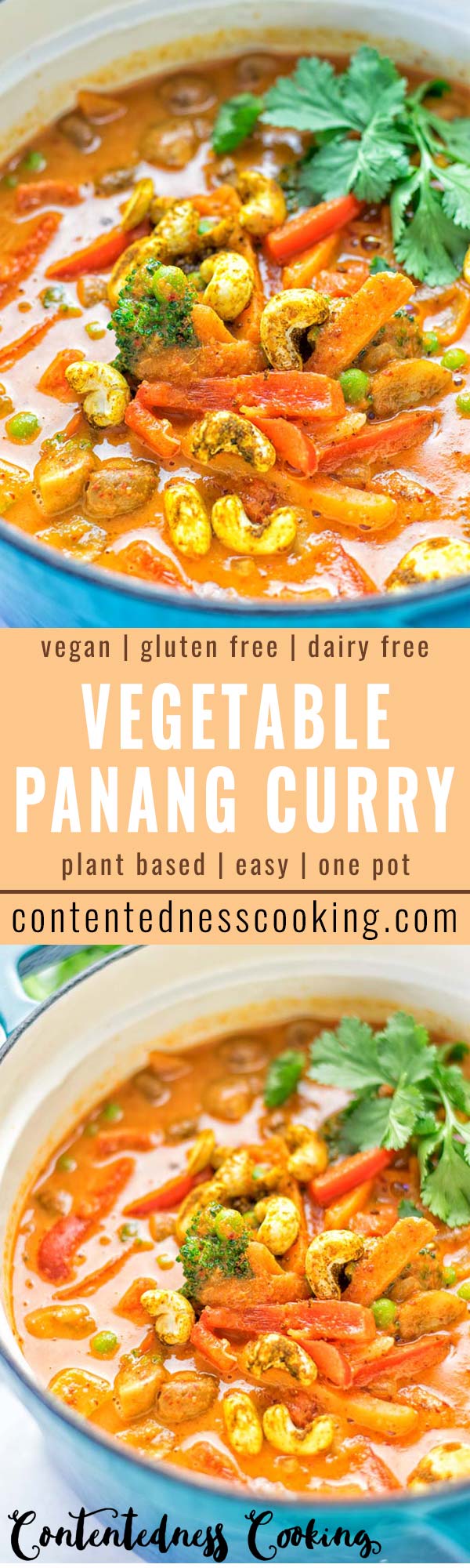
This Vegetable Panang Curry is made with Panang curry paste, coconut milk, and peanut butter - richer, slightly sweeter, and more complex than a standard red curry. With broccoli, mushrooms, peas, bell pepper, and carrots. One pot, 25 minutes, entirely plant-based.
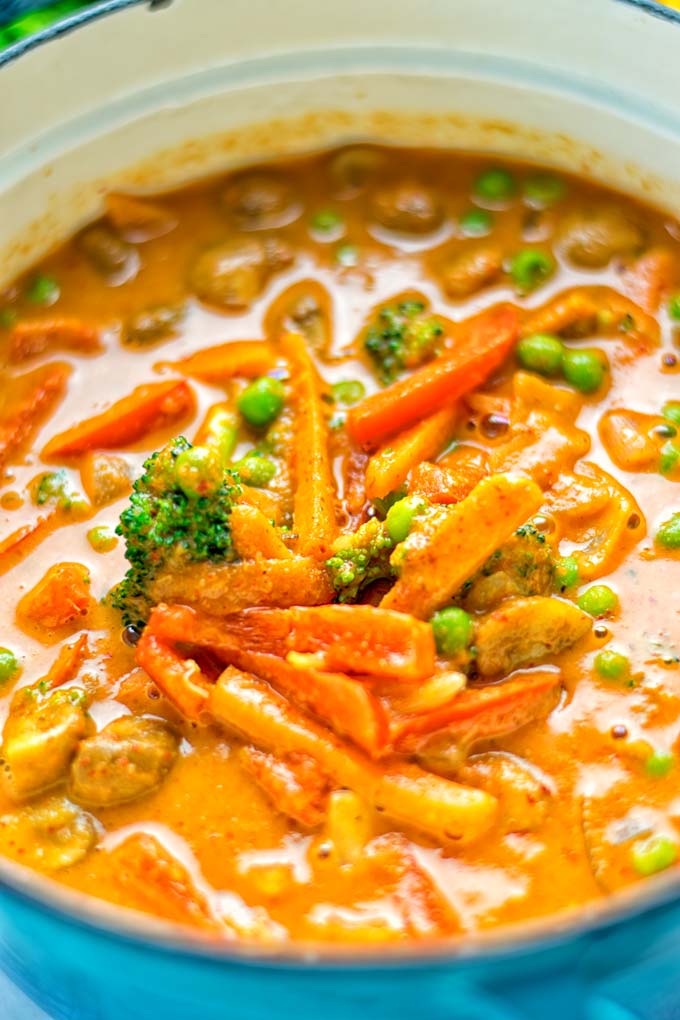
Panang curry sits between red curry and massaman on the Thai curry spectrum - richer than red, milder than green, and more fragrant than either. The defining characteristic is peanut - Panang curry paste contains ground peanuts as part of its spice blend, and this recipe reinforces that with a tablespoon of peanut butter added directly to the sauce. The result is a curry with a slightly nutty undertone and a sauce that is notably thicker and more coating than a standard coconut milk curry.
It is also the most approachable Thai curry for people who find red or green too sharp. The heat is present but gentle, the sweetness from the coconut milk and peanut butter rounds everything out, and the overall effect is more complex than you might expect from a dish ready in 25 minutes.
The vegetable mix here - broccoli, mushrooms, peas, bell pepper, onions, and carrots - is a starting point rather than a fixed list. Panang sauce works with virtually any vegetable. Corn, zucchini, eggplant, leek, and cauliflower all belong in a bowl of Panang curry. The sauce is forgiving enough to handle whatever is in the fridge.
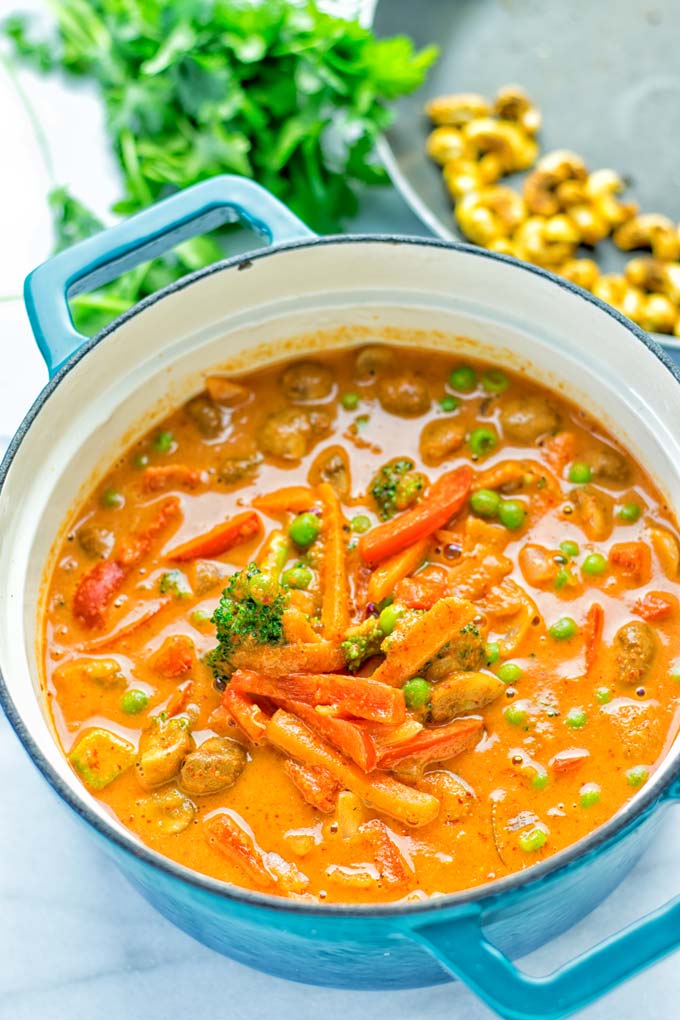
What is Panang curry?
Panang - also spelled Phanaeng - is a Thai curry originating in central Thailand, named after the Malaysian city of Penang. Unlike red or green curry, which are built primarily on heat and herbal freshness respectively, Panang curry is defined by its richness. The paste contains ground peanuts alongside the standard Thai curry aromatics - dried chilies, lemongrass, galangal, kaffir lime, and garlic - which gives it a distinctive nutty, slightly sweet depth.
Traditional Panang curry is made with meat - typically beef or chicken - and is not vegan due to the use of fish sauce and shrimp paste in the curry paste. This version uses a vegan-certified Panang paste (Maesri is a reliable widely-available option) and replaces meat with five vegetables, making it fully plant-based without compromising any of the flavor profile.
The key difference between Panang and other Thai curries in practice: Panang sauce is thicker, richer, and slightly sweeter. It coats vegetables and protein more completely than a thin red curry broth. Where red curry can feel almost soup-like, Panang feels like a proper sauce - and that quality is what makes it so satisfying.
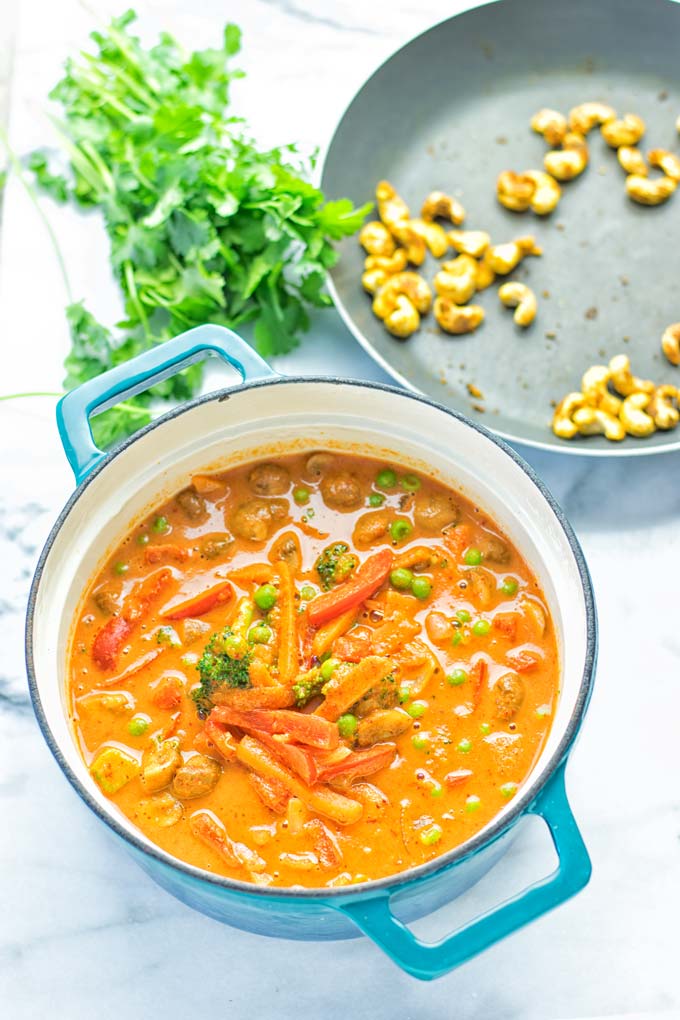
Why this recipe works
Peanut butter in the sauce. Panang curry paste already contains ground peanuts, but adding a tablespoon of peanut butter to the coconut milk base reinforces the characteristic nuttiness and thickens the sauce further. It is one ingredient that visibly changes the texture and depth of the finished curry.
Full fat coconut milk. This is non-negotiable for Panang curry. The high fat content of full fat canned coconut milk is what creates the thick, coating sauce that makes Panang distinct from thinner curries. Light coconut milk or carton varieties will not produce the same result.
Five vegetables for variety. Broccoli, mushrooms, peas, bell pepper, onions, and carrots provide different textures - crisp, earthy, sweet, and tender - that prevent the curry from feeling monotonous. The combination also ensures the vegetable base absorbs the sauce from multiple angles.
One pot, 25 minutes. Everything cooks in a single casserole from start to finish. There is no roasting, no pre-cooking, and nothing that needs to be prepared separately.
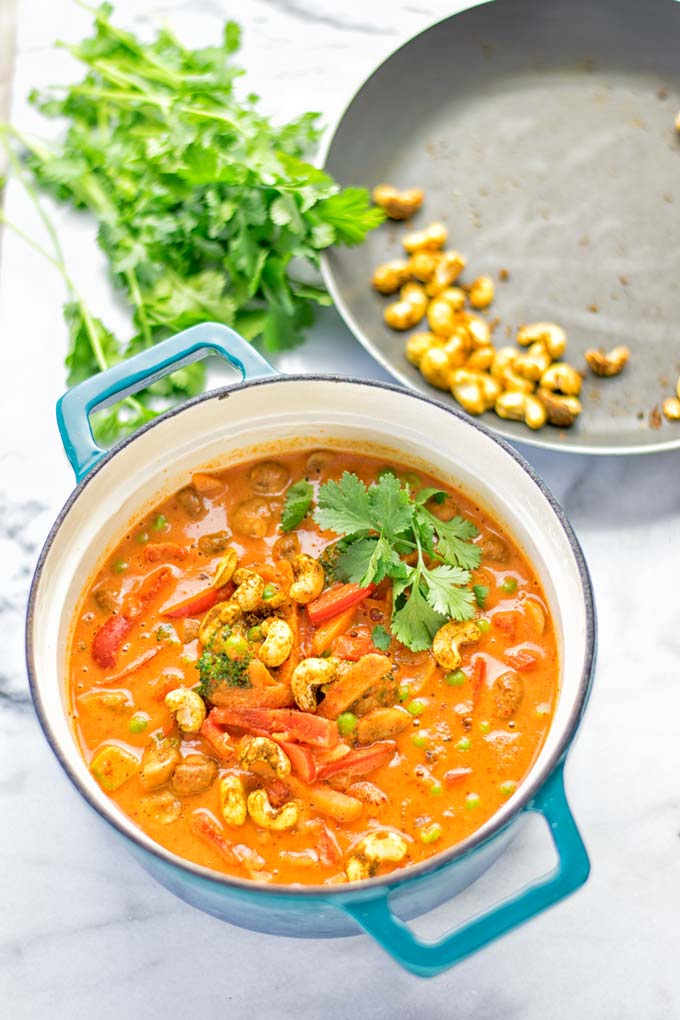
Ingredient notes
Panang curry paste - the most important ingredient. Maesri and Mae Ploy are both widely available and reliably good. Check the label - most contain shrimp paste and are not vegan. Look for a vegan-certified version. Mae Ploy's Panang paste is vegan; always verify as formulations can change. The amount used directly controls the heat level - start with two tablespoons for a milder curry and increase to three for the full flavor experience.
Coconut milk - full fat, canned. Shake the can before opening or stir the contents together if separated. Do not substitute with light coconut milk or carton plant milk - the fat content is essential for the sauce texture.
Peanut butter - one tablespoon of smooth, natural peanut butter. Do not use sweetened or flavored peanut butter - natural with no added sugar is what works here. The peanut butter reinforces the nuttiness already in the Panang paste and thickens the sauce.
Soy sauce - a small amount for seasoning. Adds depth and saltiness in a way that plain salt cannot. Use tamari for a gluten-free version.
Kaffir lime leaves - optional but worth including if available. They add a distinctive floral citrus note that is characteristic of authentic Panang curry. Fresh or frozen are both fine; dried are less effective.
Vegetables - the base recipe uses broccoli, mushrooms, peas, bell pepper, onions, and carrots. See the section below for a full guide to vegetable substitutions.
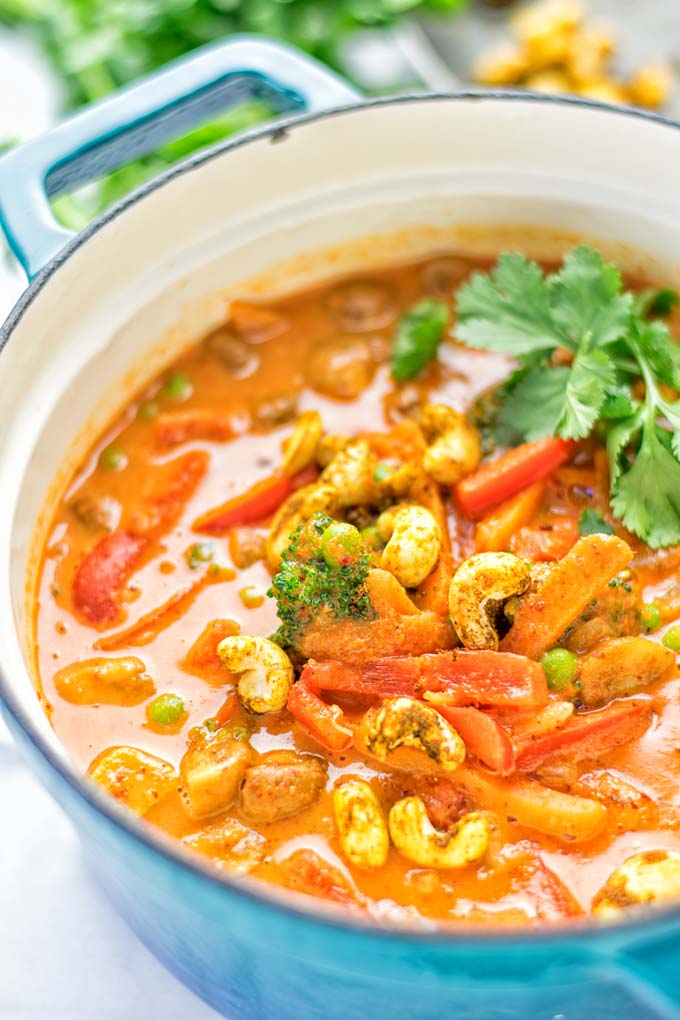
How to make vegetable Panang curry
Start with the aromatics. Heat a small amount of oil - or vegetable broth for oil-free cooking - in a large casserole over medium heat. Add the onion and cook for 3 minutes until softened. Add the bell pepper and carrots and cook for a further 2 minutes.
Add the coconut milk and Panang curry paste. Whisk or stir until the paste is fully dissolved - no streaks should remain. Add the peanut butter and soy sauce and stir to combine. The peanut butter will dissolve into the sauce as it heats.
Add the broccoli, mushrooms, and peas. Place a lid on the pot and cook on medium heat for 12-15 minutes, stirring occasionally, until the vegetables are tender but still holding their shape. The sauce should have thickened slightly and be coating the vegetables.
Taste and adjust seasoning. Add the kaffir lime leaves if using in the final 2 minutes of cooking. Serve over jasmine rice, garnished with fresh cilantro or Thai basil if available.
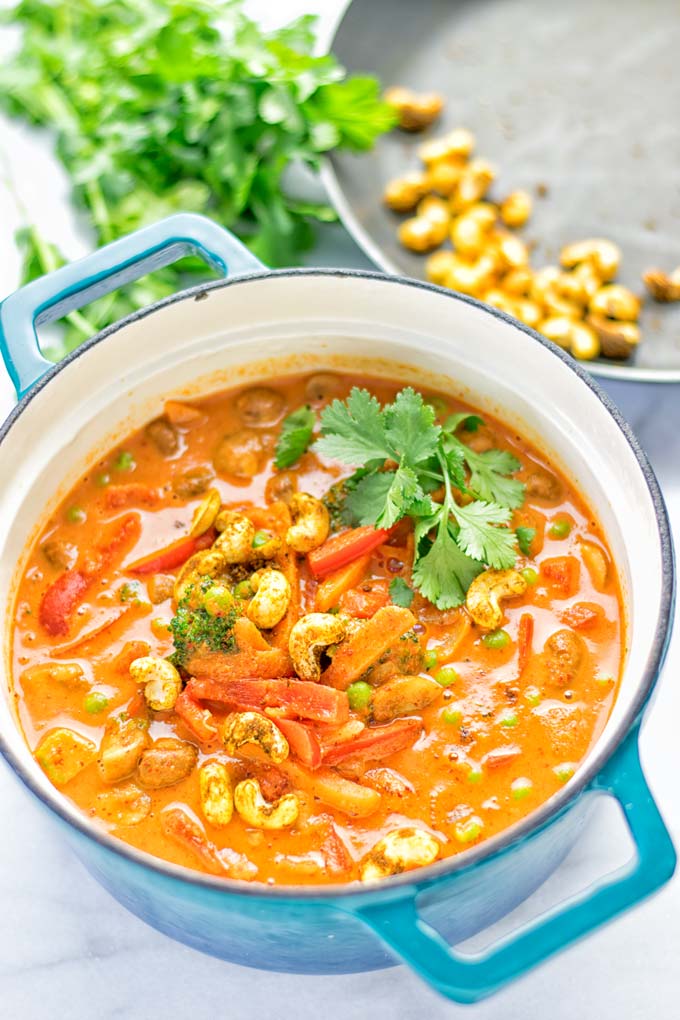
Which vegetables work best
Panang sauce pairs well with virtually any vegetable, but different vegetables behave differently in a curry. A guide to the most common additions:
Vegetables that work perfectly (add at the start with the sauce): Broccoli, carrots, eggplant, green beans, cauliflower, baby corn, potato, sweet potato, leek
Vegetables that need less cooking (add in the final 5 minutes): Zucchini, mushrooms, snap peas, spinach, bok choy, corn kernels
Vegetables to avoid: Very watery vegetables like cucumber or lettuce - they dilute the sauce and lose all texture.
The flexibility principle: Panang curry is designed to be adaptable. Change the vegetables based on what is available, what is in season, or what needs to be used up. The sauce will carry any combination - the flavor profile remains consistent regardless of the vegetable mix.
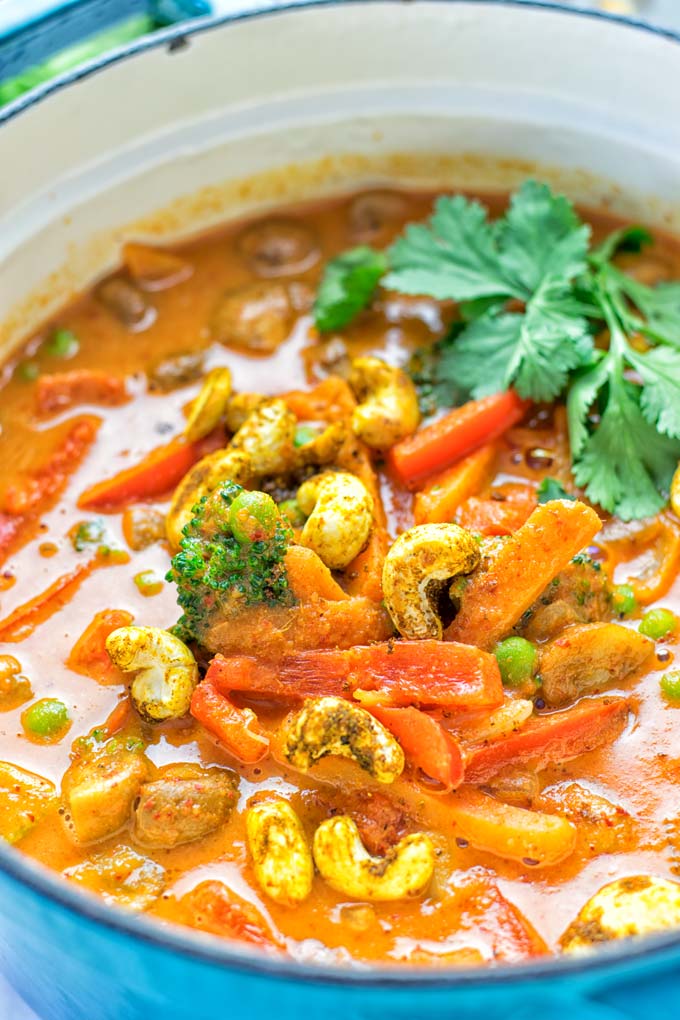
Variations
Add protein - extra-firm tofu pressed and cubed, or vegan chicken pieces, added with the coconut milk. Tofu absorbs the Panang sauce beautifully and firms up as it cooks.
Spicier version - increase the Panang paste to three tablespoons and add a pinch of red chili flakes. The base recipe is mild to medium - this takes it noticeably hotter.
More peanut - increase peanut butter to two tablespoons for a more pronounced nutty character. Some readers add a scattering of crushed roasted peanuts as a topping for extra texture.
Noodle version - replace the rice with rice noodles cooked directly in the curry sauce. Add an extra half cup of coconut milk or vegetable broth to compensate for the liquid the noodles absorb.
Lighter version - reduce the peanut butter to half a tablespoon and use light coconut milk for a thinner, less rich curry. The flavor will be less complex but still good.
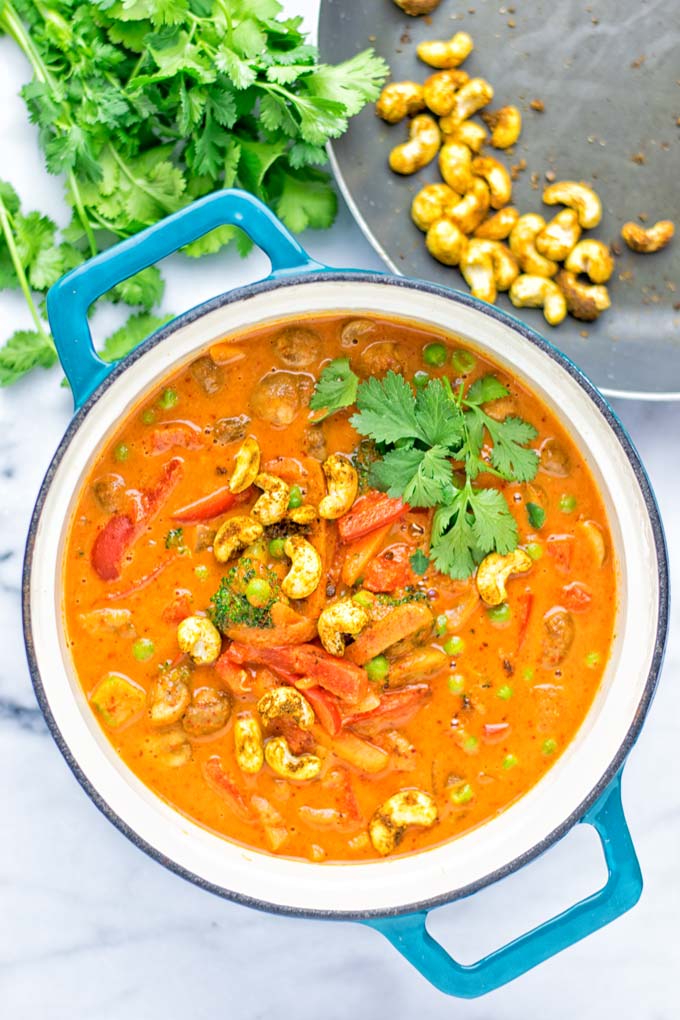
Serving suggestions
Jasmine rice - the classic pairing. The slightly sticky, fragrant character of jasmine rice absorbs the thick Panang sauce beautifully.
Brown rice - for a heartier, more nutritious base.
Rice noodles - a lighter alternative that works particularly well if adding extra liquid to the sauce.
Cauliflower rice - for a lower-carb version.
Flatbread or roti - for scooping the sauce directly.
Garnishes worth adding: Fresh Thai basil, fresh cilantro, kaffir lime leaves, a squeeze of lime, sliced red chili, or a small drizzle of coconut cream over the top before serving.
Storage and meal prep
Refrigerator: Store in an airtight container for up to 5 days. The curry thickens as it cools and often tastes better the next day as the sauce penetrates the vegetables fully. Add a splash of coconut milk or water when reheating to restore the original consistency.
Freezer: Allow to cool completely before transferring to a freezer-safe container. Freeze for up to 3 months. Thaw overnight in the fridge. Some vegetables - particularly broccoli and zucchini - will be softer after freezing, which is acceptable. Reheat gently on the stovetop.
Meal prep: This curry scales easily - double or triple the recipe without any adjustments. Store in individual portions for grab-and-go lunches throughout the week. The flavor deepens overnight, making day-two portions often preferable to freshly made.
Frequently asked questions
Both use a red chili-based paste but they produce different results. Red curry is thinner, sharper, and more broth-like. Panang curry is thicker, richer, and slightly sweeter - the ground peanuts in the paste and the addition of peanut butter create a sauce that is closer in character to a satay sauce than a standard curry broth. Panang is generally milder and more approachable for people who find red curry too sharp.
Most traditional Panang curry pastes contain shrimp paste and are not vegan. Always check the label. Maesri makes a vegan Panang paste widely available in Asian grocery stores and online. Mae Ploy's Panang paste is also vegan - but verify as formulations can change.
You can, but the result will be a red curry rather than a Panang curry - thinner, sharper, and without the characteristic nutty undertone. If substituting, reduce the quantity slightly as red curry paste tends to be hotter than Panang. The peanut butter addition still works well with red curry paste.
Yes, though the sauce will be less thick and less characteristically Panang in flavor. Almond butter is the most neutral substitute. If avoiding all nut butters, simply omit - the curry is still good without it, though closer in character to a standard red curry.
Read the ingredient list carefully. Shrimp paste (also listed as kapi or trassi) is the most common non-vegan ingredient. Anchovy or fish sauce are sometimes included. A paste with no seafood derivatives in the ingredient list is vegan. When in doubt, look for explicitly vegan-certified packaging.
Simmer uncovered for 3-5 minutes to reduce. Alternatively, stir in an additional half tablespoon of peanut butter - it thickens the sauce quickly and adds flavor rather than diluting it.
More recipes you'll love
- 10 Easy Vegan Curry Recipes
- Sweet Potato Curry
- Eggplant Curry
- Massaman Curry with Roasted Potatoes
- Lentil Chickpea Yellow Curry
- Chickpea Tikka Masala
Made this Vegetable Panang Curry? Leave a comment below and rate the recipe - it helps more people find it. Tag me on Instagram or Facebook with a photo. Florian.
Looking for more easy vegan one pot meals? See the full collection: 15 Easy Vegan One Pot Meals
See you soon, Florian.
Vegetable Panang Curry (One Pot, 25 Minutes)
Easy vegetable Panang curry made with Panang paste, coconut milk, and peanut butter — richer, slightly sweeter, and more complex than red curry. Five vegetables, one pot, 25 minutes, entirely plant-based.
Ingredients
- 3 cups mixed vegetables
- 4 Tbs Panang Curry paste
- 6 cloves garlic
- 1 14 oz can coconut milk
- 3 Tbs peanut butter
- salt, pepper to taste
- Optional;
- tandoori cashews (½ cup cashews + 3 teaspoon tandoori spice)
- ¼ cup lemon juice
- 3 teaspoon maple syrup
- 2 tbs tamari sauce
- cilantro
Instructions
- Heat a small amount of oil — or vegetable broth for oil-free cooking — in a large casserole over medium heat. Add the diced onion and cook for 3 minutes, stirring occasionally, until softened and translucent. Add the bell pepper and sliced carrots and cook for a further 2 minutes until beginning to soften.
- Pour in the full fat coconut milk and add the Panang curry paste. Whisk or stir until the paste is fully dissolved into the coconut milk — no streaks should remain. Add the peanut butter and soy sauce and stir to combine. The peanut butter will melt into the sauce as it heats.
- Add the broccoli florets, sliced mushrooms, and peas. Season with salt and pepper. Place a lid on the pot and cook on medium heat for 12–15 minutes, stirring occasionally. The vegetables are ready when tender but still holding their shape — broccoli should be vibrant green and yielding to a fork without collapsing. The sauce should have thickened slightly and coat the back of a spoon.
- If using kaffir lime leaves, add in the final 2 minutes of cooking. Taste and adjust seasoning — more curry paste for heat, a splash more coconut milk to mellow.
- Serve over jasmine rice, garnished with fresh cilantro or Thai basil if available
Notes
- Panang paste brand: Check labels — most traditional Panang pastes contain shrimp paste and are not vegan. Maesri and Mae Ploy both make vegan versions. Always verify.
- Peanut butter: Use smooth natural peanut butter with no added sugar. One tablespoon thickens the sauce and reinforces the paste's characteristic nuttiness. Increase to two tablespoons for a more pronounced peanut flavor.
- Coconut milk: Full fat canned only. Light coconut milk or carton varieties will not produce the same thick, coating sauce.
- Vegetable flexibility: Any vegetables work in Panang sauce. Add harder vegetables (potato, sweet potato, eggplant) with the sauce in step 2. Add softer vegetables (zucchini, spinach, snap peas) in the final 5 minutes.
- Heat level: The base recipe is mild to medium. Increase paste to 3 tablespoons for a notably spicier result.
- Too thin: Simmer uncovered for 3–5 minutes to reduce, or stir in an extra half tablespoon of peanut butter.
- Refrigerator: Stores for up to 5 days. Tastes better the next day as the sauce absorbs into the vegetables.
- Freezer: Freeze for up to 3 months. Some vegetables will soften after thawing — acceptable for flavor, not ideal for texture.
Nutrition Information:
Yield: 4 Serving Size: 2 cupsAmount Per Serving: Calories: 339Total Fat: 29gSaturated Fat: 22gTrans Fat: 0gUnsaturated Fat: 6gCholesterol: 0mgSodium: 86.5mgCarbohydrates: 14gFiber: 5gSugar: 6.5gProtein: 17g
this was a perfect base. the addition of peanut butter and maple in place of coconut sugar is inspired and reeeally excellent. i generally eyeball everything so naturally ended up making probably twice the recipe. only diversions I made to the original recipe were to use freshly grated tumeric root and ginger root and kaffir lime leaves (3) sauteed with a mirapoix. As I realized I didnt have any GF tamari, I used coconut aminos and some himalayan salt to compensate and a fresh finely chopped jalapeno to up the heat quotient. then added a few handfuls of fresh thai basil and cilantro at the end because why not? but honestly, this is an easily applauded base. Ill be using this a quick reference for future curries...
Thanks so much for your excellent feedback! I hope you'll find lots of more recipes to try!
Can’t get enough of this. I’m a wimp when it comes to the heat of the curry paste, but I use your recipe as a base and adjust the flavors until it’s right for me. (2.5 tbsp of curry paste per batch is about as warm as I can manage!) I’ve been adding fresh ginger when the vegetables are frying. Love the addition of tamari, maple syrup and lemon juice. I’ve been enjoying this with tofu, broccoli, mushrooms, carrots, onions and peas. Thank you for giving this recipe “good bones” so that it can be so easily adjusted!
That sounds delicious, Heather! Thanks for sharing your review and making it. Would you mind leaving a feedback with a star rating next time? It is so helpful for other readers to know about your experience. Thanks so much.
Do chop the garlic or grate it or put it in whole?
Hi Nancie! Pressed and hopes that clarifies.